
OSH Training Records – Legal Requirements in Australia
Keeping accurate training records is not just good business practice – under Australia’s OSH framework, it is essential for demonstrating compliance.
This page explains what the law requires, when training records are mandatory, and how JSEAsy helps Australian businesses manage training evidence with confidence.


Are Training Records Required Under the OSH Act?
Under the Work Health and Safety Act (OSH Act), a Person Conducting a Business or Undertaking (PCBU) must:
Provide workers with information, training, instruction and supervision necessary to protect their health and safety
Ensure training is suitable, adequate, and task-specific
Be able to demonstrate that these duties have been met
While the OSH Act does not use the words “you must keep training records” in every clause, the duty is unenforceable without evidence.
In practice, if you cannot produce training records, regulators will assume the training did not occur.
Why Training Records Are Essential for Compliance
Training records are relied on by:
OSH inspectors
Principal contractors
Courts and legal representatives
Insurers and workers’ compensation authorities
ISO auditors (ISO 45001, ISO 9001, ISO 14001)
If an incident occurs, training records are often the first documents requested.
No records = no proof = increased liability.

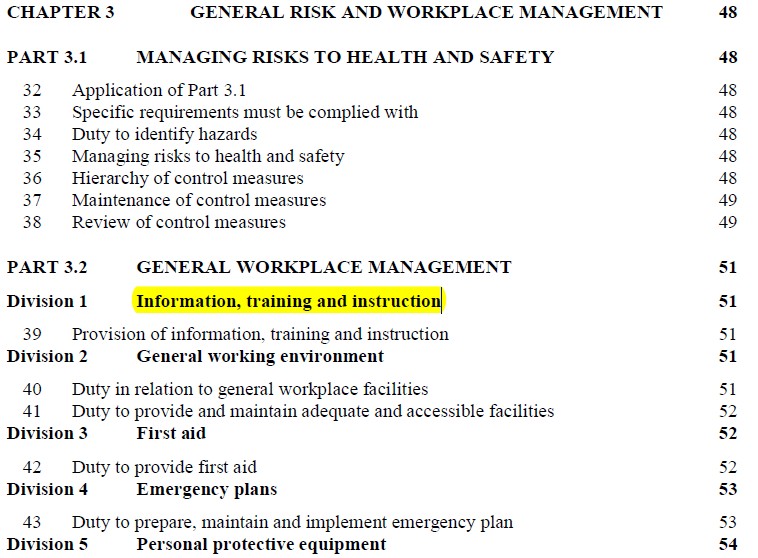
OSH Regulations That Explicitly Require Training Records
In many cases, record‑keeping is not optional. The OSH Regulations require evidence of training, competency, or licensing for high‑risk activities, including:
High Risk Work Licences (forklifts, cranes, dogging, rigging)
Construction Induction Training (White Card)
Asbestos awareness and removal training
Confined space entry training
Hazardous chemicals and dangerous goods training
Health monitoring and exposure records
Plant and equipment operator competency
Emergency response and first aid training
Failure to keep records in these areas is a direct breach of the OSH Regulations.
Codes of Practice – The Enforceable Benchmark
Approved Codes of Practice issued by Safe Work Australia consistently state that PCBUs should:
Keep records of training and instruction
Ensure records are current, accessible, and appropriate to the work
Retain records for the duration of employment, and longer where required
Courts treat Codes of Practice as the minimum expected standard when assessing compliance.
What Should a OSH Training Record Include?
A legally defensible training record should capture:
Worker name
Training topic or competency
Date completed
Trainer or training provider
Method (online, toolbox talk, formal course)
Evidence (certificate, sign‑off, assessment)
Expiry or refresher date (where applicable)
A simple attendance sheet is not sufficient for high‑risk or regulated activities.
Model Codes of Practice:
- Abrasive blasting
- Confined spaces
- Construction work
- Demolition work
- Excavation work
- First aid in the workplace
- Hazardous manual tasks
- Healthcare and social assistance industry
- How to manage and control asbestos in the workplace
- How to manage work health and safety risks
- How to safely remove asbestos
- Labelling of workplace hazardous chemicals
- Managing electrical risks in the workplace
- Managing noise and preventing hearing loss at work
- Managing psychosocial hazards at work
- Managing risks in stevedoring
- Managing the risk of fatigue at work
- Managing risks of hazardous chemicals in the workplace
- Managing risks of plant in the workplace
- Managing the risk of falls at workplaces
- Managing the risk of falls in housing construction
- Managing the work environment and facilities
- Managing risks of respirable crystalline silica in the workplace
- Preparation of safety data sheets for hazardous chemicals
- Safe design of structures
- Sexual and gender-based harassment
- Spray painting and powder coating
- Tower cranes
- Welding processes
- Work health and safety consultation, cooperation and coordination

Common Compliance Failures
Regulators frequently identify these issues during audits and investigations:
Training completed but no records retained
Out‑of‑date licences or expired training
No link between training and actual tasks performed
Inductions completed but no refresher training recorded
Records stored in multiple locations with no central control
These failures are easily preventable with a structured system.
How JSEAsy Helps You Manage Training Records
JSEAsy provides a practical, audit‑ready way to manage OSH training across Australian workplaces:
Centralised training and competency records
Induction and refresher tracking
Training matrices linked to roles and tasks
Evidence registers (certificates, licences, sign‑offs)
Easy access during audits and site inspections
Alignment with OSH legislation and ISO standards
JSEAsy turns training evidence into a defensible compliance system, not a paperwork headache.


Who Needs to Keep Training Records?
Training records are critical for:
Construction companies and subcontractors
Manufacturing and warehousing businesses
Transport and logistics operators
Plant and equipment hire companies
Facilities management and maintenance contractors
Any business with site‑based or high‑risk work
If you employ workers or engage contractors, you are expected to keep training records.
Summary – The Legal Reality
The OSH Act requires training – records prove it happened
The OSH Regulations often mandate record‑keeping
Codes of Practice reinforce training records as best practice
No records means you cannot demonstrate compliance
Training records are not optional. They are a core part of OSH risk management.


Frequently Asked Questions (FAQ)
Are OSH training records legally required in Australia?
While the OSH Act focuses on providing training rather than paperwork, PCBUs must be able to demonstrate compliance. In practice, this means keeping training records. Many OSH Regulations explicitly require records for high-risk work, licences, and competencies.
How long must OSH training records be kept?
Training records should be kept for the duration of employment and longer where required by regulation, Codes of Practice, or health monitoring obligations.
Do contractors need training records?
Yes. PCBUs must ensure workers and contractors are trained and competent. Evidence of induction, task-specific training, and licences should be retained.
What happens if training records are missing?
If you cannot produce records during an inspection or investigation, regulators may assume training was not provided, increasing the risk of enforcement action or prosecution.
Is a sign-on sheet enough as a training record?
For low-risk activities, it may assist. For high-risk or regulated work, more detailed evidence such as certificates, assessments, or competency verification is expected.
Want to simplify OSH training records?
Explore how JSEAsy helps Australian businesses manage inductions, training, and competency evidence with confidence.
The JSEAsy Premium Environmental Health and Safety (EHS) Software is your completed OSH management system.